
Complications and Warning Signs: What Can Go Wrong and When to Get Help
Hysterectomy complications and warning signs, explained honestly in plain language: the honest numbers, and exactly which symptoms need a prompt call or emergency help.

This guide is for education only and is not medical advice. Kelette Health does not provide medical care and does not create a doctor-patient relationship. Talk to your own clinician about your situation. If you have a medical emergency, call your local emergency number.
Key to abbreviations: ACOG: American College of Obstetricians and Gynecologists · RCOG: Royal College of Obstetricians and Gynaecologists
Why this guide exists: Most hysterectomies go smoothly, and most women recover without any complication. But "most" is not "all," and you deserve the honest numbers and the clear list of warning signs, in plain language, before you ever need them. This guide explains what can go wrong, how often the published figures say it happens, how complications are treated, and exactly which symptoms should make you call promptly or seek emergency help. It is the seventh guide in the Kelette Health Hysterectomy series.
An honest note about the numbers: Published leaflets do not all quote the same figures, because they describe different routes, hospitals, and years. This guide uses one named published set throughout: the Royal College of Obstetricians and Gynaecologists figures for abdominal hysterectomy, as published in the Leeds Teaching Hospitals patient leaflet. Abdominal surgery carries the highest risks of the three routes, so treat these numbers as the upper end; your surgeon's own figures for your route are the ones that matter most. ACOG's patient guide lists the same complications without giving frequencies.
The complications, one by one:
- Serious complications overall: About 4 in 100 women having an abdominal hysterectomy have a serious complication of some kind. Serious here means problems such as major bleeding, organ injury, or a return to the operating theatre.
- Bleeding needing transfusion: About 23 in 1,000. Bleeding can happen during surgery or in the days after, including blood collecting at the top of the vagina, called a vault hematoma, which may drain on its own or need treatment.
- Injury to the bladder or ureter: About 7 in 1,000. The bladder and the ureters, the tubes carrying urine from kidney to bladder, lie close to the uterus. Injury may be repaired during the operation; occasionally it is only discovered afterwards, which is one reason worsening abdominal pain with fever and vomiting after surgery always deserves assessment. Some women have bladder irritation, frequency, or urine infections after surgery without any injury at all.
- Injury to the bowel: About 4 in 10,000 in this published set; know that some other hospital leaflets quote higher figures, up to about 1 in 250, which is why this guide names its source rather than pretending there is one settled number. Bowel injury is usually repaired during surgery or with a further operation.
- Infection: The most common complication family: urine infection, chest infection, wound infection, and pelvic infection or abscess (about 2 in 1,000 for abscess). Treatment is antibiotics, sometimes in hospital, and drainage if an abscess forms.
- Blood clots: About 4 in 1,000 for a clot in the leg or lung. Prevention is built into your care: early walking, sometimes compression stockings or blood thinning injections. A clot in the leg is treated with blood thinning medicine; a clot travelling to the lung is an emergency.
- Return to the operating theatre: About 7 in 1,000, usually for bleeding or repair.
- Hernia at the scar: Fewer than 1 in 100 after abdominal surgery, appearing months later as a bulge; repaired with surgery if needed.
- Death: About 32 in 100,000 within six weeks for planned abdominal hysterectomy in this published set. It is rare, and it is listed here because honest information includes it.
- Anesthetic complications: Serious problems from a general anesthetic are about 1 in 10,000 in the same figures.
The vaginal cuff, explained: When the cervix is removed, the top of the vagina is closed with stitches; that closure is called the vaginal cuff. Two problems belong to it. A vault hematoma is a collection of blood above the cuff, described under bleeding. Cuff dehiscence is the rare event of the cuff opening partly or fully, sometimes with tissue bulging through; it typically happens weeks after surgery and sex before healing is complete is the most common trigger, which is why the pelvic rest in Guide 6 (h6) matters. No patient facing source we found publishes a reliable rate for it, so this guide gives none rather than inventing one. It is a surgical emergency: if you feel sudden pelvic pressure or something coming down, or have sudden watery discharge or bleeding weeks after surgery, go to emergency care at once.
Ovarian failure, even when the ovaries stay: The ovaries share part of their blood supply with the uterus, so removing the uterus can occasionally reduce ovarian function even when the ovaries are kept, bringing menopause earlier than expected. UK guidance requires warning women of this possibility before surgery. It is one of the frequent risks listed in hospital leaflets, alongside temporary bladder symptoms and scar numbness.
Later problems:
- Adhesions: Internal scar tissue that can cause pelvic pain, painful sex, and rarely bowel blockage months or years later.
- Prolapse later: The vaginal vault can descend over time, particularly after hysterectomy done for prolapse, where about 1 in 10 women later need treatment for another prolapse. Pelvic floor exercises for life, as in Guide 6 (h6), are the standing protection.
- Pain that does not improve: When surgery was done for pelvic pain, pain sometimes persists, especially if its source was not the uterus. This possibility should be faced before surgery, not discovered after.
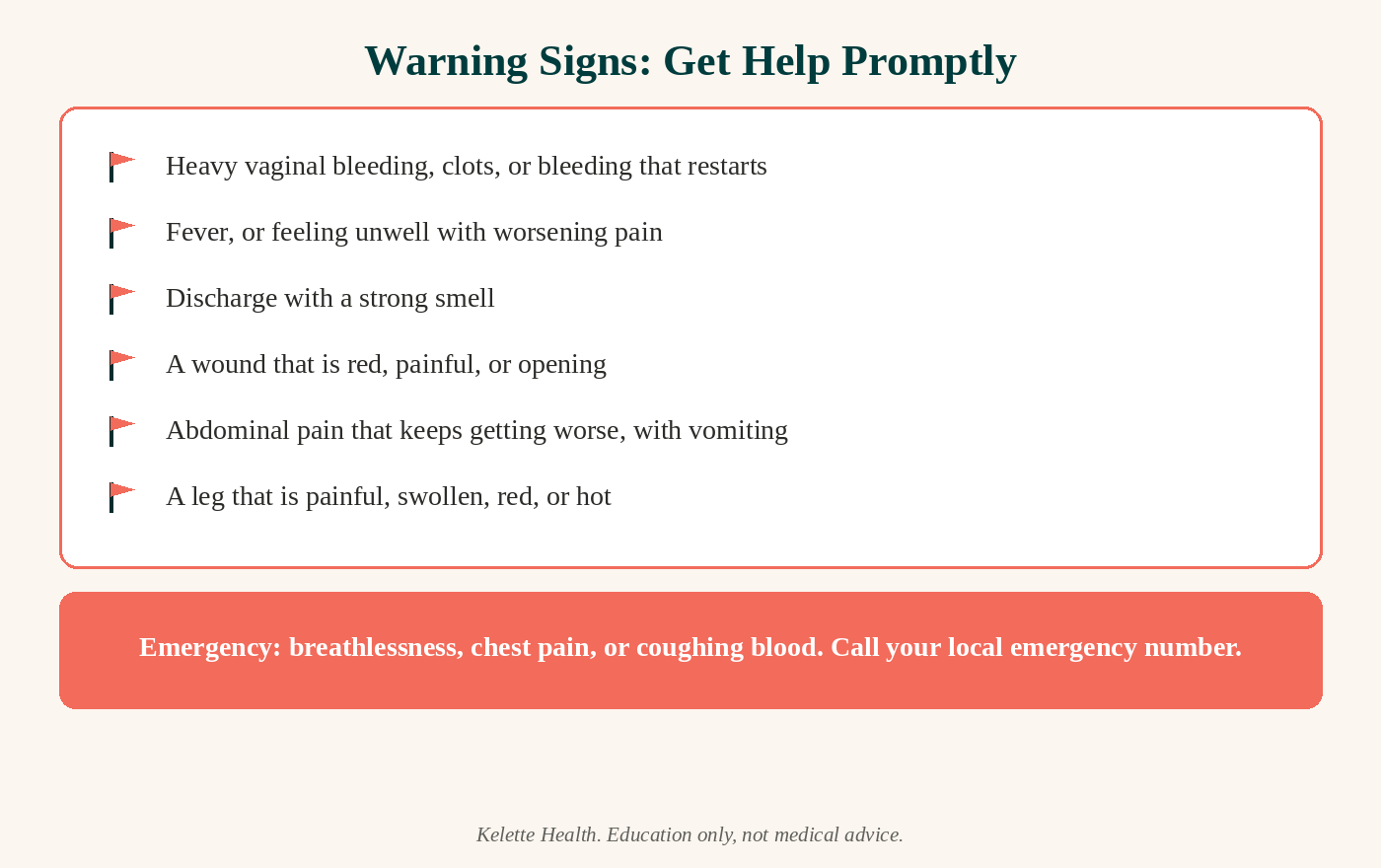
Warning signs: call your team promptly:
- Urinary symptoms: Burning or stinging when you urinate, or needing to go very often: likely a urine infection.
- Bleeding changes: Heavy or smelly vaginal bleeding, bleeding that restarts after easing, or passing clots.
- Wound changes: Skin around a scar that is red, painful, hot, or opening.
- Infection pattern: Fever, or feeling increasingly unwell rather than steadily better.
- Abdominal pattern: Increasing abdominal pain with fever, loss of appetite, and vomiting: this combination can signal bowel or bladder injury and needs hospital assessment.
- Leg symptoms: A leg that is painful, swollen, red, or hot, or hurts to stand on: possible blood clot.
Warning signs: emergency help now:
- Breathlessness, chest pain, or coughing blood: These can signal a clot that has travelled to the lung. Call your local emergency number or go to emergency care immediately.
- Very heavy bleeding: Soaking through pads rapidly, feeling faint or dizzy with bleeding.
- Sudden pelvic pressure or something bulging into the vagina weeks after surgery: Possible cuff opening, as described above.
How complications are managed, in general: Most complications are treatable, and earlier is easier: infections with antibiotics; bleeding with observation, transfusion, or occasionally a return to theatre; organ injuries with repair, sometimes involving a urologist or bowel surgeon; clots with blood thinning medicine and monitoring. The management that matters most is yours: recognizing the signs above and acting on them the same day rather than waiting to see.
Outside the US:
- Consensus: The complication list and the warning signs are the same in US and UK patient materials, nearly word for word on the warning signs.
- United Kingdom (RCOG and NHS trusts): The figures in this guide come from the Royal College's consent advice as published by NHS hospitals; other trusts quote somewhat different figures, which is stated openly above.
- United States (ACOG): ACOG's patient guide lists the categories, fever and infection, heavy bleeding, injury to the urinary tract or nearby organs, blood clots that can travel to the lungs, anesthesia problems, and later bowel blockage, and notes complications are more common with the abdominal route.
Questions women ask:
- How will I know the difference between normal pain and a problem: Normal pain improves a little most days. Problems announce themselves by reversal: worse instead of better, or new fever, new bleeding, new swelling. Trust the direction of travel.
- My discharge smells slightly. Should I call: A strong or offensive smell, especially with fever or feeling unwell, is on the call list. Mild discharge without those features is a normal part of healing.
- I am terrified of clots. What actually protects me: Walking early and often, the stockings or injections your team prescribes, and not smoking. Then know the two signposts: the painful swollen leg, and breathlessness or chest pain as an emergency.
- If I need a second operation, does that mean the first failed: No. A return to theatre is a recognized part of surgical care when bleeding or injury needs repair; it is the correct response, not a verdict on your surgeon.
- Who do I call at night: Your surgical team's number first, your discharge papers will carry it; your own clinician or urgent care next; the emergency number for the emergency signs above. Do not wait until morning with those.
Sources:
-
Leeds Teaching Hospitals NHS Trust. "Having a Hysterectomy." Patient information, including the Royal College of Obstetricians and Gynaecologists risk figures for abdominal hysterectomy. https://www.leedsth.nhs.uk/patients/resources/having-a-hysterectomy/
-
American College of Obstetricians and Gynecologists. "Hysterectomy." FAQ008. 2026. https://www.acog.org/womens-health/faqs/hysterectomy
-
American College of Obstetricians and Gynecologists. "Recovery After Hysterectomy: What You Need to Know." 2026. https://www.acog.org/womens-health/experts-and-stories/the-latest/recovery-after-hysterectomy-what-you-need-to-know
-
Royal College of Obstetricians and Gynaecologists. "Laparoscopic hysterectomy: recovering well." Patient information. https://www.rcog.org.uk/en/patients/patient-leaflets/laparoscopic-hysterectomy
-
NHS. "Hysterectomy: Recovery." https://www.nhs.uk/tests-and-treatments/hysterectomy/recovery/
The Hysterectomy series: This is Guide 7 of 8. Previous: Recovery Week by Week. Next: Life After Hysterectomy. See the whole series: Hysterectomy: A Guide Series.
This guide is for education only and is not medical advice. Kelette Health does not provide medical care and does not create a doctor-patient relationship. Talk to your own clinician about your situation. If you have a medical emergency, call your local emergency number.
Complications are the exception, and knowing their signs is what keeps them that way. Read this guide once, keep it where you can find it, and act on it without hesitation if the day ever comes.
Chukwuma M Okoroji, MD, FAAFP, FACOG